
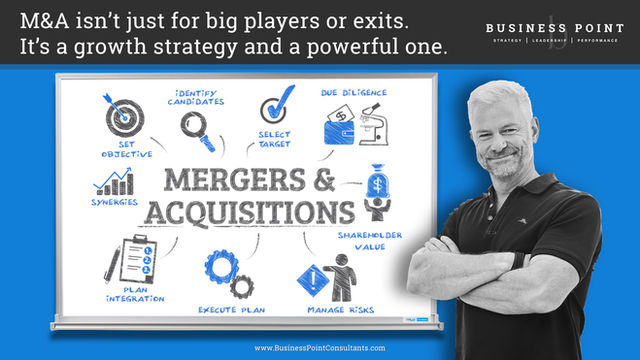
M&A is often seen as something that only big corporates and institutional investors do, based on the dark arts of financial engineering.
That is certainly one angle, but I see a missed opportunity for smaller businesses to benefit from strategic M&A as part of their own growth plans.
I work with my clients to view M&A as a strategic lever in the toolkit, not just a financial play. Done right, acquisitions can be a powerful tool to accelerate growth, deepen capabilities, expand markets, and future-proof your business.
Why buy?
As a business owner, you have a few levers available to you. You can innovate and build organically, you can partner strategically, and you can buy. Buying is often the fastest way to leapfrog into new products, new geographies, or new customer segments, and I am betting that your competitors are not making this a priority.
The best acquisitions do more than pad the top line; they unlock strategic value. They enable you to move faster and do multiple things at once. They can fill capability and capacity gaps in your current team by bringing in great talent, and ultimately create synergies that make the combined business more competitive.
Buy to grow, not to flip
When your acquisition strategy is anchored in growth, you think differently.
Investors will only buy if they are clear on their ability to sell at a later point.
As a business owner using M&A as a growth strategy, you are looking for more than assets you can tidy up and sell on. You are looking for businesses that fit: strategically, operationally, and culturally. You care deeply about integration, about shared values, about how the two businesses can become more than the sum of their parts.
Buying to grow is about scale with intent. The aim is a more resilient, more capable, and more valuable business over time, rather than short-term returns.
Strategic triggers for M&A
We have helped clients use M&A to solve big strategic problems. Some common scenarios include:
- Capability acquisition. Need a new tech platform or specialised service offering? Buying can be faster and cheaper than building your own.
- Market entry. Want to enter a new region or sector? Buying a local player can give you instant credibility and reach.
- Customer base expansion. Acquiring a business with a strong client portfolio can instantly accelerate your growth.
- Talent acquisition. In a competitive labour market, sometimes the best way to hire a high-performing team is to acquire them.
- Vertical integration. Control more of your supply chain or value chain by bringing upstream or downstream players in-house.
Integration is the real challenge
Getting a deal done is often the easy part. I have read lots of depressing stats on how many acquisitions fail to deliver the anticipated value. In my experience, these failures rarely come down to the finance guys getting the model wrong. They come from a failure of integration once the deal is done. This is more cultural than commercial and is often treated as an afterthought rather than the strategic priority that it is.
The quality of your plan to merge operations, teams, systems, and cultures is a key predictor of value creation. Without it, all the upside you have forecast can quickly fall apart. That is why we work closely with clients to identify great targets and then spend the time planning the integration thoughtfully and deliberately, with clear success measures and leadership alignment.
Business Point's role
We help you define an M&A strategy that is aligned with your goals. We assess opportunities on strategic fit as well as price, and support you through due diligence, negotiation, and post-acquisition integration.
To talk about what this could look like for your business, book a confidential conversation with me.